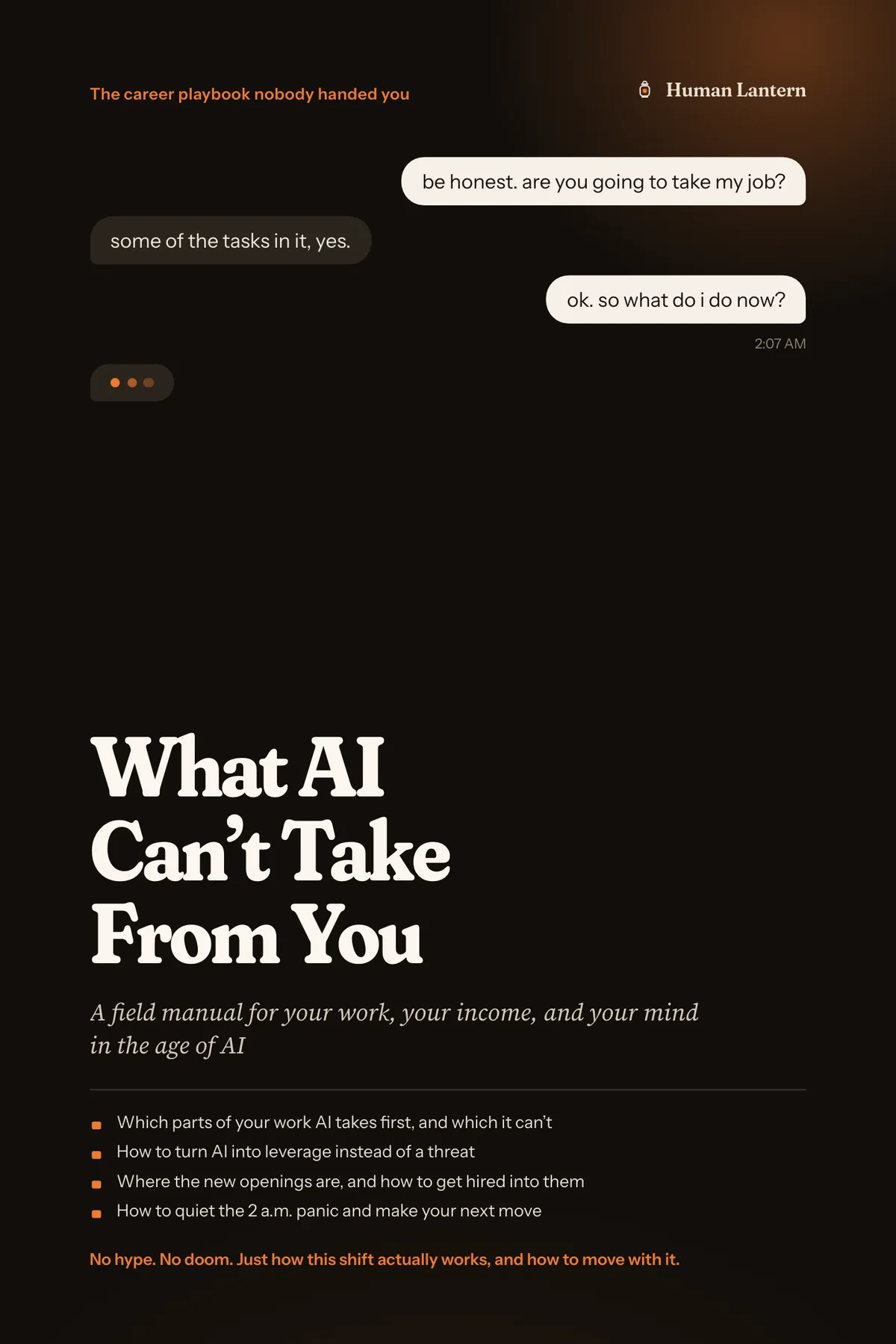
The career playbook nobody handed you
What AI Can’t Take From You
A field manual for your work, your income, and your mind in the age of AI
- Which parts of your work AI takes first, and which it can’t
- How to turn AI into leverage instead of a threat
- Where the new openings are, and how to get hired into them
- How to quiet the 2 a.m. panic and make your next move
One-time purchase
$7.99
PDF · 122 pages
88 chapters · 12 parts
All three editions included: English, Deutsch, 日本語
Get the book now- Read instantly after paying
- 7-day refund
- Secure checkout by Stripe
- English, German and Japanese editions
No account needed. Pay on Stripe’s secure page and your book is ready to read or download on the very next page.
From the first page
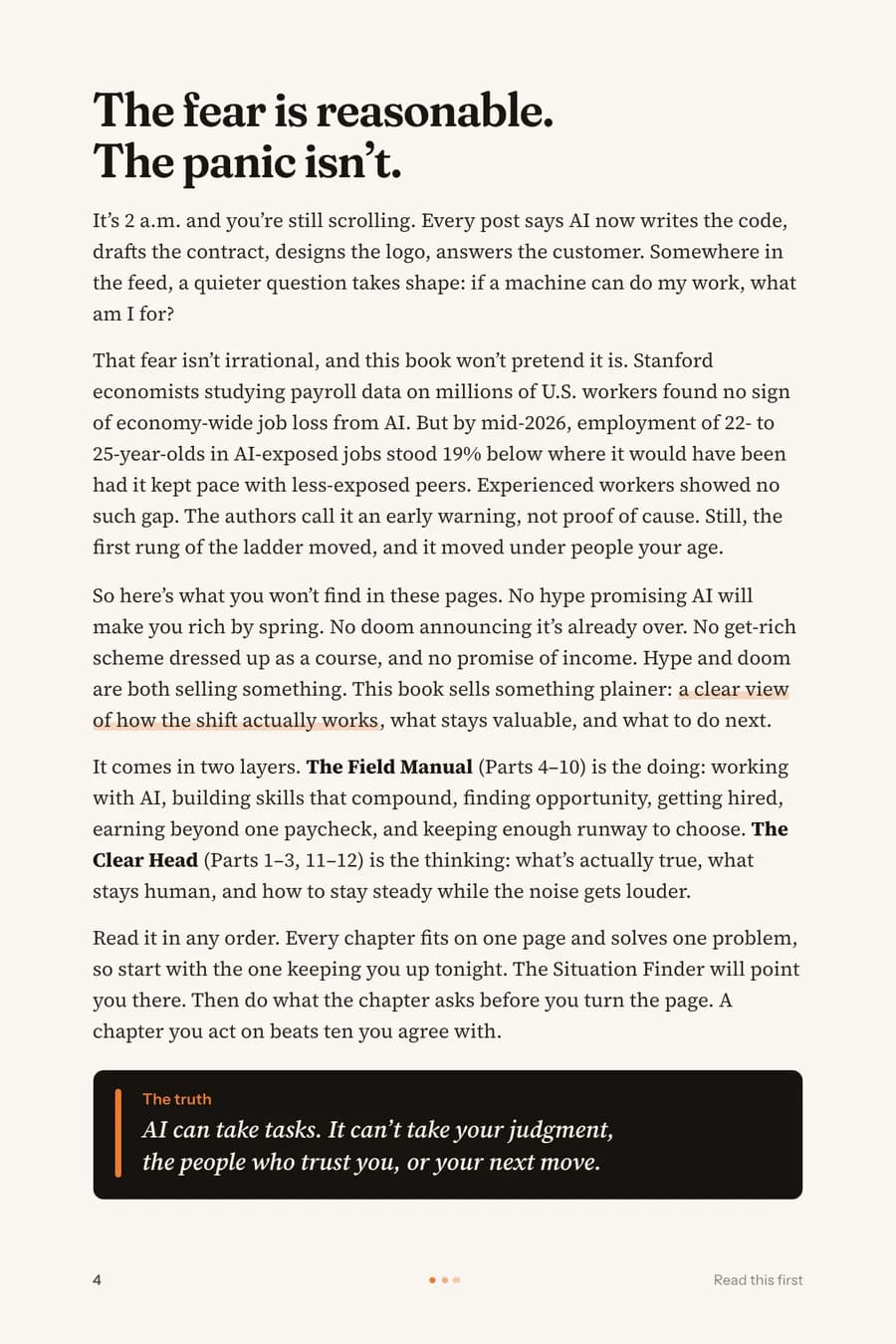
The fear is reasonable. The panic isn’t.
It’s 2 a.m. and you’re still scrolling. Every post says AI now writes the code, drafts the contract, designs the logo, answers the customer. Somewhere in the feed, a quieter question takes shape: if a machine can do my work, what am I for?
That fear isn’t irrational, and this book won’t pretend it is. Stanford economists studying payroll data on millions of U.S. workers found no sign of economy-wide job loss from AI. But by mid-2026, employment of 22- to 25-year-olds in AI-exposed jobs stood 19% below where it would have been had it kept pace with less-exposed peers. Experienced workers showed no such gap. The authors call it an early warning, not proof of cause. Still, the first rung of the ladder moved, and it moved under people your age.
So here’s what you won’t find in these pages. No hype promising AI will make you rich by spring. No doom announcing it’s already over. No get-rich scheme dressed up as a course, and no promise of income. Hype and doom are both selling something. This book sells something plainer: a clear view of how the shift actually works, what stays valuable, and what to do next.
Look inside
Every chapter fits on one page and solves one problem.
Read it front to back once. Then keep it close, and come back to the page you need on the day you need it.
Read this first
Page 4
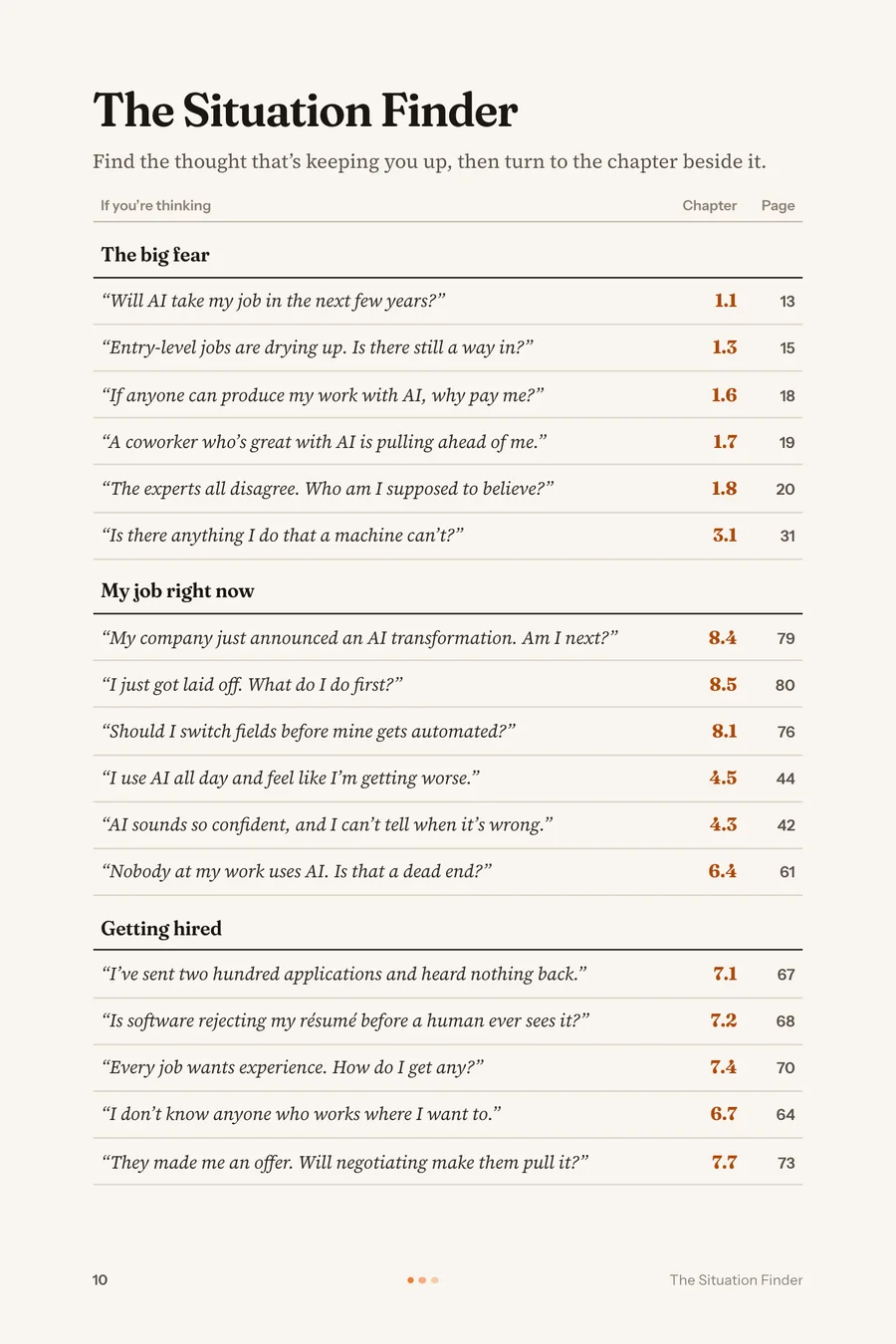
The Situation Finder
Page 10
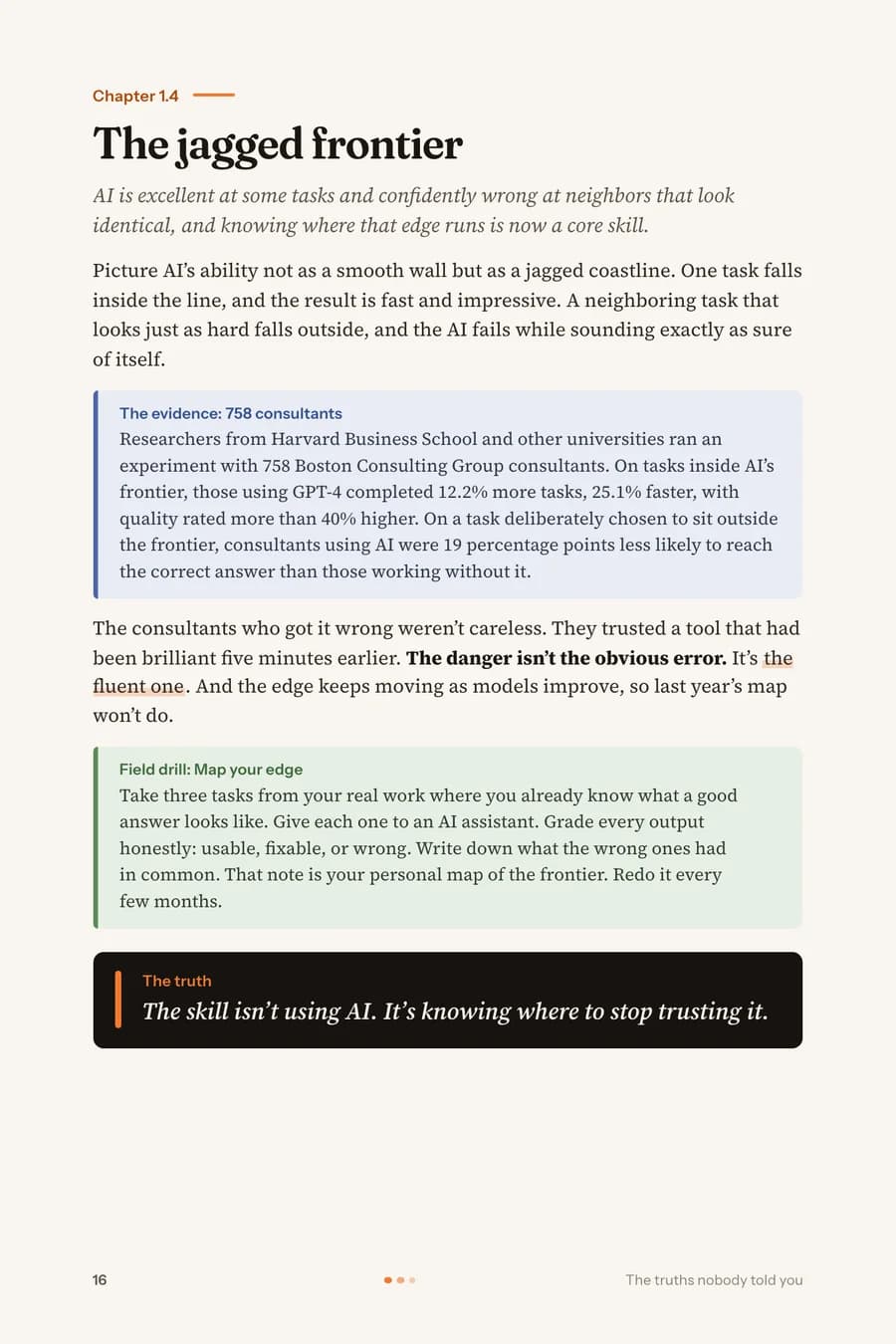
Chapter 1.4 · The jagged frontier
Page 16
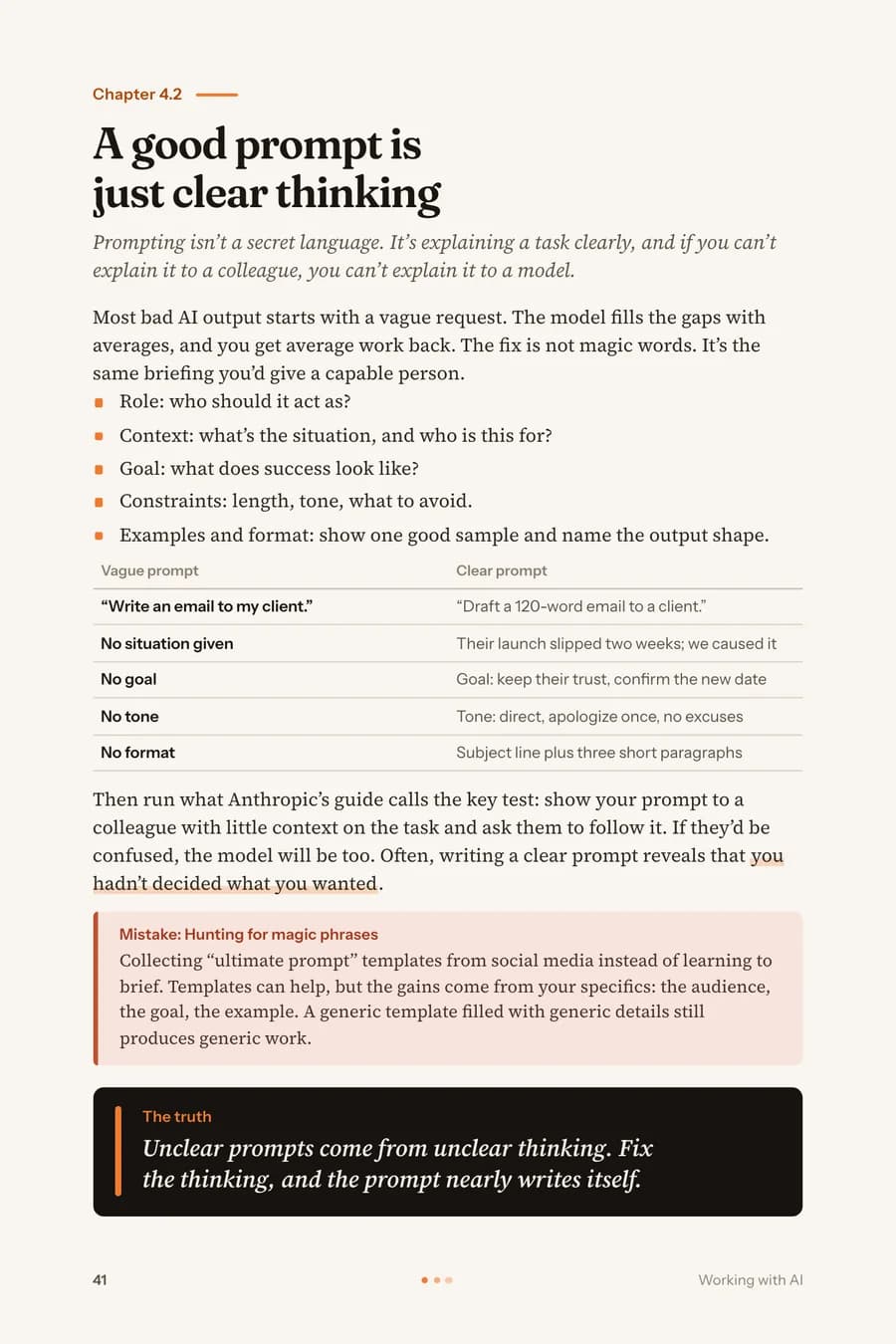
Chapter 4.2 · A good prompt is just clear thinking
Page 41
Six recurring tools
Built to change what you do, not just what you know.
Every chapter fits on one page and solves one problem; six recurring tools do the heavy lifting.
The evidence
A real, checkable study, report or case, with the author, year and source named. If a famous finding is disputed or failed to replicate, the box says so. No invented numbers, ever.
Prompt
A ready-to-paste instruction for any AI assistant. Fill the [brackets] with your own details, leave out anything private, then question the answer. Treat the reply as a fast intern’s first draft, not a verdict.
Say this
The exact words for a hard conversation with a boss, recruiter, interviewer or client, including what to say when they push back. Adapt them to your voice. Having the first sentence ready is half the nerve.
Field drill
One concrete action you can finish today in under 30 minutes. Reading changes how you feel. Drills change what happens next.
Mistake
The common self-sabotage, named precisely so you can catch yourself mid-move. Most are things smart, anxious people do with good intentions. Spotting one early can save you months.
The truth
The one line to remember if you forget everything else on the page. Copy the ones that land, and put them where you’ll see them.
Contents
12 parts, 88 chapters.
From what AI really changes to your next 30 days: the evidence, what stays human, working with AI, skills, openings, getting hired, career moves, income, money, your mind, and the long game.
01The truths nobody told youThe Clear Head · 8 chapters
Most of what you’ve heard about AI and work comes in two flavors: hype and panic. Both skip the evidence. This part is the evidence: what the best studies actually show about jobs, tasks, beginners, experts and the future. Some of it is reassuring. Some of it isn’t. All of it is more useful than fear.
- 1.1AI doesn’t take jobs. It takes tasks.
- 1.2Every machine age had its panic
- 1.3The first rung is the one that moved
- 1.4The jagged frontier
- 1.5AI lifts the bottom faster than the top
- 1.6When output gets cheap, judgment gets expensive
- 1.7You’re not competing with AI. You’re competing with people who use it well.
- 1.8Nobody knows the future, including the experts
02A clear head in a loud decadeThe Clear Head · 8 chapters
The noise around AI is loud, and much of it is built to keep you scrolling. A clear head isn’t a personality trait. It’s a set of habits: how you handle fear, what you read, who you compare yourself to, how you decide and how you rest. This part gives you those habits.
- 2.1Anxiety is a signal, not a plan
- 2.2Doomscrolling is not research
- 2.3Hype and doom are both selling something
- 2.4Control what you can touch
- 2.5The comparison trap
- 2.6You are not your job title
- 2.7Small bets beat grand plans
- 2.8Rest isn’t a reward. It’s equipment.
03What stays humanThe Clear Head · 8 chapters
When machines can write, draw, code and summarize on demand, what’s left for you? More than you think, though not what most people guess. This part maps the human work that gains value as output gets cheap: choosing, vouching, caring, framing, working with your hands, and knowing what nobody wrote down. That is where your leverage lives.
- 3.1Judgment: knowing what good looks like
- 3.2Taste is a skill, and you can train it
- 3.3Trust still runs on people
- 3.4Someone has to sign their name
- 3.5The physical world is stubborn
- 3.6The right question is the scarce part
- 3.7Being heard by a human still matters
- 3.8Context is your moat
04Working with AIThe Field Manual · 8 chapters
This is the practical part. No magic prompts, no secret tools: just the working habits that make AI useful, the checks that keep it from embarrassing you, and the traps that quietly make you worse. Think of it like learning to drive. Most of the skill is knowing when to brake.
- 4.1Treat it like a brilliant intern with no context
- 4.2A good prompt is just clear thinking
- 4.3Check anything that matters
- 4.4Build your personal AI workflow
- 4.5Where AI quietly makes you worse
- 4.6What never to paste into a chatbot
- 4.7Learn faster with AI without fooling yourself
- 4.8Ten tasks to hand off this week
05Skills that compoundThe Field Manual · 8 chapters
Tools change every year. The skills that make you good with any tool barely change at all. This part covers eight of them: learning, writing, numbers, range, domain depth, persuasion, building, and stacking. None requires genius. Each gets more valuable the longer you practice it, and each makes the next one easier to learn.
- 5.1Learn how to learn
- 5.2Writing is thinking you can see
- 5.3Numbers keep you from being fooled
- 5.4Depth plus range
- 5.5Your field plus AI beats AI alone
- 5.6Speak so people act
- 5.7From user to builder
- 5.8Build a skill stack, not a single skill
06Finding the opportunityThe Field Manual · 8 chapters
Opportunity rarely announces itself as “AI opportunity.” It shows up as a complaint, a backlog, a budget line, a stranger’s question. This part trains your eye to spot it in places others ignore, and shows you how to make sure the right people know you can help. Seeing it is half the work; being seen is the other half.
- 6.1Opportunity hides in friction
- 6.2Follow the money and the pain
- 6.3Boring industries, wide-open doors
- 6.4Be the AI person in a non-AI room
- 6.5Proof beats credentials
- 6.6Widen your luck surface
- 6.7Weak ties open strong doors
- 6.8Read the signals early
07Getting hired nowThe Field Manual · 8 chapters
Hiring has turned into an arms race: candidates use AI to apply everywhere, and employers use software to filter everything. In that noise, a clear signal is rare and valuable. This part shows you how to be that signal, from the first application to your first quarter in the job. Volume is cheap now. Credibility isn’t.
- 7.1The application flood, and how to step out of it
- 7.2A résumé that survives software and a human
- 7.3Referrals still win
- 7.4The portfolio project that gets replies
- 7.5What interviews test now
- 7.6Use AI in your search without faking it
- 7.7Negotiate the first offer
- 7.8Your first 90 days
08Moves inside your careerThe Field Manual · 7 chapters
Once you’re in, the questions get harder. Should you switch fields? Is the degree worth it? Do you need to code? What do you do when your company goes all in on AI, or lets you go? This part swaps panic for simple tests and concrete moves. Every career move is a bet, so place it with open eyes.
- 8.1Should you switch fields? A decision test
- 8.2Is a degree still worth it?
- 8.3Should you learn to code?
- 8.4When your company announces “AI transformation”
- 8.5The first week after a layoff
- 8.6Climbing when AI flattens the ladder
- 8.7Hard to replace, without burning out
09Income beyond one paycheckThe Field Manual · 7 chapters
A paycheck feels safe because it arrives on schedule. But it rests on one employer, one manager and one budget line. This part shows how to build a second stream without burning out: freelancing, small products, an audience you own, spotting get-rich schemes, honest pricing and the one-person business. Small and real beats big and imagined.
- 9.1One income is a single point of failure
- 9.2Freelancing when the first draft is free
- 9.3Turn what you know into a product
- 9.4An audience is an asset you own
- 9.5Spot the AI get-rich scheme
- 9.6Price the outcome, not the hours
- 9.7The one-person business, AI-powered
10Money that buys you timeThe Field Manual · 6 chapters
Money matters in this book for one reason: time. Savings buy you months to learn, search, switch or say no. This part is general education, not personal financial advice. It covers runway, fixed costs, lifestyle creep, hype, investing in yourself and the bad year that eventually comes. Calm is something you can save for.
- 10.1Runway is freedom
- 10.2Fixed costs decide your options
- 10.3Lifestyle creep quietly eats your runway
- 10.4Don’t bet your runway on hype
- 10.5The best early return is usually you
- 10.6Plan for the bad year
11Mind and body under pressureThe Clear Head · 6 chapters
Every skill in this book runs on one piece of equipment: your mind. It needs attention, sleep, people and a reason to get up, and the AI decade is quietly bidding for all four. This part is maintenance for the machine that matters most. Treat it like the asset it is.
- 11.1Attention is the new scarcity
- 11.2Deep work in a shallow world
- 11.3Loneliness is a career risk
- 11.4Sleep, movement, daylight
- 11.5When it’s more than worry
- 11.6Purpose isn’t found. It’s built.
12The long gameThe Clear Head · 6 chapters
This decade won’t be won in a sprint. The people who do well are likely to be the ones still learning, still connected and still steady in year ten. This part is about time: how small efforts stack, where to aim, and how to turn this book into the next 30 days and 12 months. Start small. Keep going.
- 12.1Compounding beats intensity
- 12.2Write the letter from ten years out
- 12.3Build a life AI can’t automate
- 12.4Your next 30 days
- 12.5The 12-month map
- 12.6What AI can’t take from you
This book is for you if
- You read AI headlines late at night and feel your chest tighten.
- You’re early in your career and the first rung looks like it’s moving.
- Every guru tells you to learn something different, and you don’t know whom to trust.
- You want to use AI well without losing the skills that make you valuable.
- You want a plan for this year, not a prediction about 2040.
It isn’t for you if
- You want a get-rich-with-AI scheme. This book takes them apart.
- You want to be told that everything will be fine, or that it’s all over.
- You’re looking for a technical course on building AI models.
Three promises we keep
No hype. No doom. No invented numbers.
No hype
AI is real and powerful. That doesn’t make every AI course, tool or income scheme worth your money. We say which is which, and why.
No doom
Some jobs will shrink and the first rung is moving. Most work changes shape instead of vanishing. You get the honest picture and a next step, not a verdict.
No invented numbers
Every statistic names its source. When a famous finding is debated or measured exposure rather than losses, we say so. You deserve to check.
Buying
Questions about the purchase
What exactly do I get?
The full first edition of What AI Can’t Take From You as a PDF, in English, German and Japanese: 88 one-page chapters in twelve parts, the Situation Finder, ready-to-paste prompts, scripts for hard conversations, a 30-day plan, a 12-month map, and notes listing every source. Read it in your browser or download it.
How much is it? Is it a subscription?
$7.99, once. No subscription and no upsells. Updates to this edition are free.
How do I get the book after paying?
Right away. The page you land on after paying has buttons to read the book in your browser or download the PDF, in any of the three languages. Lost it later? Enter your checkout email at humanlantern.com/download and we send it again.
Do I need an account?
No. There is nothing to sign up for and no password. You enter your email on Stripe’s secure checkout page; that email is how we find your order if you ever need the file again.
Which languages is it in?
English, German and Japanese. One purchase includes all three editions, so you can read in your first language and share the ideas in another.
What if it isn’t for me?
Email us within 7 days of buying for a full refund. No forms, no arguments.
What appears on my card statement?
A short descriptor ending in HMNLANTERN, never the book’s title. The payment page itself shows Human Lantern.
Not sure yet? Read all of Part 1 free before you decide.
What AI Can’t Take From You
Stop doomscrolling. Start moving.
88 one-page chapters, a Situation Finder for the night you need it, and a 30-day plan. All three language editions. $7.99, once.
No hype. No doom. 7-day refund, no questions asked.